
YS Holdings
Owned for the long term.
Founded by serial entrepreneurs who built and sold VC-backed cyber companies — now leading the next generation of bootstrap in the AI builders era. Angels only. Niche markets. Arbitrage.
Read the story
01 — Origin
Why YS Holdings exists
We have done the VC-backed cycle before — built cyber companies, scaled them, sold them. That path teaches speed, rigor, and how capital can amplify a product. It also teaches what ownership costs when the next round writes the roadmap. YS Holdings is the deliberate next chapter: bootstrap for the AI builders era.
The bet is not anti-venture. It is pro-control. We raise from angels — people who underwrite operators, not pitch theater — and we refuse the default assumption that every serious company must become a fundraising machine. In this decade, models, tools, and distribution primitives are cheap enough that a sharp team can compound without surrendering the stack. Capital still matters. Dependency on institutional VC does not have to.
YS Holdings exists to lead that generation of company building: efficient teams, durable ownership, and products aimed at value in niche markets and arbitrage — places where focus beats spectacle. We are a holding company because the right shape is ownership across more than one surface, not a single narrative dressed as a unicorn slide.
The thesis is concrete. Consumer AI only wins where people trust it with intimate context. Attention markets reward systems that operate faster than a human media buyer. Edge infrastructure wins where cloud round-trips fail the product bar. Those problems look separate in a deck. In practice they share the same constraints: latency, privacy, cost of intelligence, and the discipline to ship without burning capital for applause.
We are early. That is intentional. Early is when ownership is still available, when architecture can still be honest, and when a small team can still choose depth over theater. The pages that follow are not a brochure of logos. They are the story of what we are building, why the pieces belong together, and how we intend to hold them.

02 — Method
How we build
Our method starts with efficiency. In the AI builders era, the scarce resource is not access to models — it is judgment about where intelligence creates real value. We build lean, ship early, and aim at niches sharp enough to own: intimate consumer contexts, attention arbitrage, and edge environments the cloud cannot serve honestly.
On-device privacy is not a marketing line for us. It is an architectural gate. If a product touches family life, health adjacent routines, workplace premises, or anything a user would hesitate to paste into a chat window, inference should stay as close to the user as the silicon allows. Apple’s ecosystem makes that gate enforceable on iPhone and iPad. Edge hardware like NVIDIA Jetson makes it enforceable in the physical world. We design products to those realities instead of apologizing for them later.
Automation leverage is the second gate. Humans are excellent at strategy, taste, and judgment under ambiguity. Humans are expensive at refreshing creatives, reallocating spend every hour, watching dashboards, and repeating the same operational loop across accounts. Where a market rewards speed and volume — especially arbitrage markets — we build systems that absorb the grind. The goal is not to remove people from the business. The goal is to stop paying people to do what software can do at machine cadence.
Edge compute is the third gate. There are environments where the cloud is simply the wrong place for intelligence: factories, vehicles, cameras, offline sites, regulated premises, anything that needs an answer in tens of milliseconds or cannot send raw sensor streams off-site. We treat those environments as first-class product surfaces, not afterthoughts bolted onto a SaaS roadmap.
Put together, the method is boring on purpose. Prefer local inference when intimacy or latency demands it. Prefer automated loops when markets punish hesitation. Prefer hardware-aware software when the world is not a browser tab. Build efficiently. Own the niche. Hold the product. Improve it. Repeat.

03 — Venture I
01
Parenting Copilot
An AI parenting companion for new parents — more confident, not more overwhelmed. Built for Apple. Privacy first.
The belief
Parents don’t need more data — they need more understanding. Every sleep stretch, feeding window, and developmental shift produces a trail of moments. Traditional baby trackers are excellent at recording that trail and terrible at making sense of it. Charts accumulate. Anxiety does too. The category has mistaken logging for care.
We believe the next product for new parents is not a denser dashboard. It is an intelligent companion: baby tracking, personalized AI, and long-term memory in one product that helps parents understand their child’s unique patterns, anticipate what comes next, and preserve the moments that matter — without adding noise to a life that already has enough of it.
The product
Parenting Copilot is an AI-powered baby tracking app built for new parents who want confidence, not another feed of conflicting advice. Unlike traditional trackers that only record data, it understands routines, recognizes patterns, answers questions from the child’s own history, and offers personalized guidance that actually fits this family — not a generic parenting tip recycled from the internet.
Intelligent insights, beautiful design, and privacy-first AI come together as a true parenting companion, not just another tracker. The experience is calm on purpose: clear answers when you need them, continuity across messy days, and a product that grows with your family instead of treating every week like a cold start.
Apple, privacy, intelligence
Family data stays private. Parenting Copilot is built from the ground up for Apple’s ecosystem — iPhone and iPad first — so the product can live where parents already are, with the privacy and craft bar that ecosystem demands. On-device foundation models and private inference keep guidance and context close to the device whenever capability allows. The household does not need to become a remote prompt window for the product to work.
That constraint is not a limitation we market around. It is the product boundary. When intelligence runs with the family’s data treated as intimate — not as fuel for a cloud default — trust becomes something you can demonstrate. Latency improves. Offline resilience improves. And the companion earns the right to sit in someone’s pocket during the most private hours of the day.
Why it matters
Parenting Copilot transforms baby tracking into an intelligent companion that grows with your family. It is also a proving ground for consumer AI people will actually allow into intimate life: if intelligence cannot be private and personal, it stays stuck in low-stakes novelty. If it can remember, understand, and guide — without overwhelming — it opens a much larger surface of products that deserve to exist. This venture is our first full expression of that bet.

04 — Venture II
02
Ads arbitrage on Meta
Attention is a market. We build systems that buy, sell, and optimize it on Meta at machine speed.
Attention as a market
Advertising on Meta — Facebook and Instagram — is often described as creative craft. That is half true. The other half is market microstructure: auctions, pacing, creative fatigue, audience drift, learning phases, and the constant repricing of attention. Humans can set strategy. Humans cannot, at any serious scale, watch every signal and reallocate every hour without becoming the bottleneck.
We treat attention as an arbitrageable market — exactly the kind of niche where bootstrap operators win by owning the loop, not by narrating the opportunity. That does not mean spam. It means respecting the economic reality of the platform: creative that works decays; audiences saturate; costs move; winners are systems that notice and act before the edge is gone. The opportunity is not a clever one-off campaign. It is ownership of the loop.
Automation on Meta
This venture builds automation across Meta’s advertising surfaces. Spend allocation, creative rotation, testing discipline, and feedback loops that tighten the relationship between what runs and what returns. The software is meant to absorb the operational grind that usually eats an ads team alive: the refresh cadence, the kill decisions, the budget shifts, the tireless comparison of what looked good yesterday and what is dead today.
Strategy remains human. Taste remains human. The machine owns the tempo. That split is deliberate. Markets that clear continuously punish organizations that only clear when someone has a free afternoon. If your competitor’s system can reprice and remix while your team is in a meeting, you are not competing on creative. You are competing on latency of judgment.
Machine-speed optimization
The product goal is leverage that compounds. Each loop should make the next allocation sharper: better creative survivors, cleaner audience hypotheses, less wasted spend in the dead zone between “looks promising” and “is finished.” We are not building a prettier reporting dashboard. Dashboards are where urgency goes to die. We are building operators — systems that act inside the market’s clock, not systems that narrate the market after the fact.
Meta is the first arena because the liquidity is there and the automation surface is rich. The deeper asset is the operating system for attention: software that can sit on top of large spend, keep human strategy in the loop, and refuse to let execution speed be limited by headcount. That asset belongs inside a holding company because it generates power that can support other products — including the consumer and edge lines — without forcing every venture to invent its own growth machine from scratch.
Why it matters
Monetization engines are often treated as unglamorous compared with consumer AI demos. That is a mistake. Durable companies need a way to buy distribution without romanticizing organic growth. Owning an ads arbitrage stack on Meta is how YS Holdings builds that muscle: concrete, measurable, and fast enough to matter — value extracted from a niche market at machine cadence.
05 — Venture III
03
AI on the edge
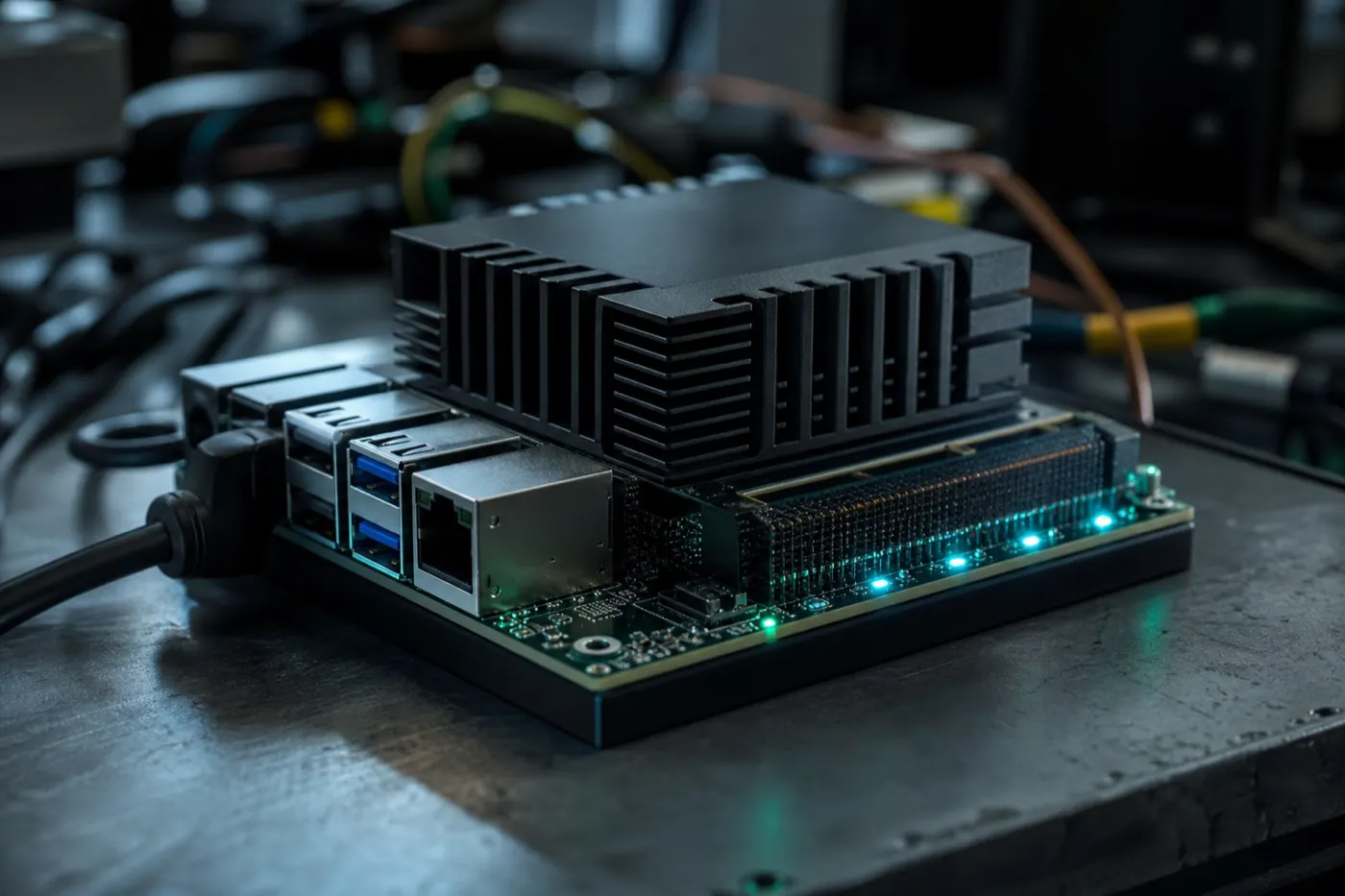
Real-time local inference on NVIDIA Jetson Orin Nano Super — where the cloud is too far, too slow, or too open.
When the cloud fails the product
Cloud AI is extraordinary until it is not. Round-trips to a region introduce latency that kills closed-loop control. Bandwidth costs explode when cameras and sensors stream raw truth off-site. Premises with weak connectivity become product graveyards. And some data should never leave the building — not because a policy document says so, but because the business, the regulator, or the physical risk model will not tolerate it.
Those failure modes are not edge cases. They are the normal conditions of factories, logistics yards, vehicles, clinics, retail floors, and any environment where intelligence must meet the physical world in real time. Shipping a cloud-only answer into those environments is how teams discover, late and expensively, that their architecture was a demo.
Jetson Orin Nano Super
This venture builds edge AI on NVIDIA Jetson Orin Nano Super hardware — compact, power-aware silicon meant to sit next to the sensor, the camera, the machine. Models run locally. Inference happens where the event happens. The product can keep working when the wide-area network is ugly, expensive, or intentionally unavailable.
We care about the Orin Nano Super class of device because it sits at a useful intersection: enough performance for serious real-time inference, small enough to deploy outside a datacenter aesthetic, practical enough to own as infrastructure rather than theater. Hardware is not the product by itself. Hardware is the permission structure that makes local intelligence possible.
Real-time local inference
The software work is pairing models to that silicon so latency and confidentiality are properties of the system, not wishes in a slide. Detection, classification, anomaly response, and other closed-loop tasks need answers measured in milliseconds and centimeters, not in regional hop counts. When the model lives next to the data, you stop paying the cloud tax on every frame and you stop exporting premises detail as a side effect of “using AI.”
Edge does not mean isolation from the rest of the stack. Aggregates can still move upstream. Fleet learning can still exist. Updates can still ship. The point is sovereignty over the critical path: the moment of inference that makes the product real. Everything else is optional plumbing.
Why it matters
Edge AI matters to YS Holdings because it is another niche where focus beats spectacle — the same privacy-and-latency thesis we pursue on phones, applied where the world cannot wait for a region. Consumer devices and industrial devices look different. The principle is shared: put intelligence next to the event, and where trust cannot survive a default upload. Owning that capability is how we stay relevant when AI leaves the chat box and enters the physical plant.

06 — System
Portfolio as a system
Three ventures can look like a scattered bet. Ours are meant to reinforce each other — and each is a niche we intend to own. Parenting Copilot is the consumer AI line: an intelligent parenting companion on Apple, privacy-first, built to understand families rather than merely log them. The Meta ads stack is the monetization engine: machine-speed arbitrage in attention markets. Jetson-class edge work is the infrastructure line: local inference for physical and premises-bound reality. Separately, each is a company. Together, they are a bootstrap holding thesis with shared muscle.
Consumer AI teaches us what people will actually trust. That discipline hardens product judgment across the portfolio — especially the refusal to treat private data as fuel for remote convenience. The ads engine teaches us distribution economics without mythology. Growth stops being a prayer and becomes a system that can support products when organic channels are slow or saturated. Edge infrastructure teaches us how to ship intelligence outside the browser, which matters the moment any product line touches cameras, machines, or offline environments.
There is also a talent and tooling flywheel. On-device and edge work share an instinct for constrained compute. Automation work shares an instinct for feedback loops and operational ruthlessness. Holding these under one company lets patterns travel without the friction of three disconnected startups reinventing the same internal scaffolding. We are not forcing artificial synergies on a slide. We are refusing to strand useful capability in silos — and refusing to raise institutional capital just to look larger than the work requires.
The long game is simple to say and hard to execute: own consumer surfaces that deserve intimacy, own engines that can buy attention efficiently, and own infra that keeps inference local when the cloud is the wrong tool. That is the system. Everything we add later should strengthen one of those sides — or the joints between them — not dilute the thesis with novelty for its own sake.
07 — Principles
How we decide
Six operating principles. Short enough to remember. Strict enough to reject work that only looks impressive.
-
Ship real products
Holdings mean operating companies, not slide decks. We measure progress by software people use and systems that run in production. A brilliant architecture that never ships is research cosplay. We would rather own an imperfect product in the market than a perfect narrative in a room.
-
Build efficiently
Bootstrap is a design choice. We raise from angels, not institutional VC — deliberate ownership, not bitterness. Capital should amplify a product that already works, not invent urgency for a fundraising calendar. Small teams, sharp niches, and compounding capability beat theater every time.
-
Privacy by architecture
When intimacy or premises confidentiality is part of the product, inference should stay local whenever capability allows. Privacy is not a footer link and not a future roadmap item. It is a design constraint that decides what we build, what we store, and what we refuse to send upstream.
-
Niche value and arbitrage
Prefer markets where focus creates durable edge — intimate consumer contexts, attention arbitrage, edge environments the cloud cannot serve. If a loop can improve spend, creative, or decisions without linear headcount, we build the loop. Human judgment stays on strategy and taste. Machine tempo owns the grind.
-
Edge when the cloud fails
Latency, bandwidth, connectivity, and data sovereignty are product requirements, not infrastructure footnotes. When a region hop breaks the experience, we put silicon and models next to the event. The physical world does not care about your preferred cloud region.
-
Long-term holding mindset
Own what we build. Optimize for durable value over quarterly theater. Patience is not an excuse for slow shipping; it is a refusal to sell the future of a working product for a short spike of attention. We are here to hold through the boring years where compounding actually happens.
08 — Next
Coming soon.
Building in the open.
YS Holdings is still early — which is exactly when the story should be told without costume. Serial operators. Angel capital. Bootstrap discipline for the AI builders era. Products are shipping across consumer AI, attention arbitrage, and edge infrastructure. If you are an angel, a partner, or an operator who recognizes the thesis, we want the conversation.
The next chapters will be written in releases, not press releases. Until then, this page is the map: why we exist, how we build, and what we are holding.
Parenting Copilot Meta Ads Edge AI
Start a conversation hello@sheli.ninja